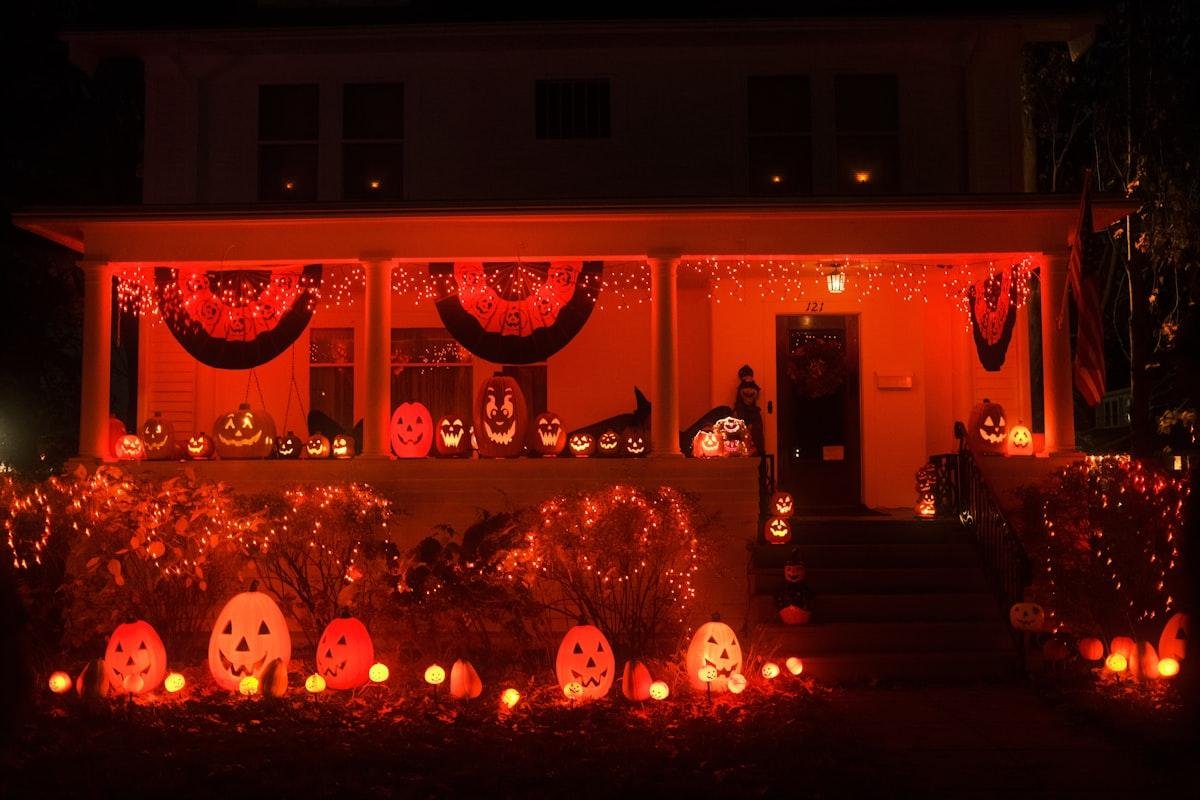
The best idioms for Halloween are the ones English already uses year-round: skeleton in the closet, witching hour, scared stiff, ghost town, come back to haunt you. They sound seasonal in October, but every one is a working idiom whose meaning has nothing to do with the holiday, which is exactly why they’re worth teaching, captioning, and stealing for party invitations.
Most lists stop at meaning and example. Sorting matters more, because a phrase that fits an eighth-grade worksheet may not fit an adult party caption, and one or two carry an origin story worth telling out loud. So the 24 below come grouped by where they actually work.
Classroom-Safe Halloween Idioms
These twelve are the ESL and elementary staples: clean, common, and easy to act out.
- Scared stiff: too frightened to move. “The thunder left the dog scared stiff under the table.”
- Scaredy-cat: someone easily frightened. “Don’t be a scaredy-cat, it’s just a costume.”
- Ghost town: a place emptied of people. “By 9 p.m. the mall was a ghost town.”
- Night owl: a person who stays up late. “Every night owl loves October.”
- Witching hour: the dead of night, when spooky things supposedly happen. “The baby wakes at the witching hour.”
- Come back to haunt you: a past mistake causing trouble later. “Skipping the reading came back to haunt him at the exam.”
- Skeleton in the closet: a hidden embarrassing secret. “Every family has a skeleton in the closet.”
- Let the cat out of the bag: reveal a secret. “She let the cat out of the bag about the surprise party.”
- Spill your guts: tell everything. “Okay, spill your guts, what happened at the dance?”
- Make your blood boil: make you furious. “Litter on the trail makes my blood boil.”
- Dig your own grave: cause your own downfall. “Lying to the coach was digging his own grave.”
- Over my dead body: absolute refusal. “You’ll wear that to Grandma’s over my dead body.”
Sharper Idioms for Adult Captions and Cards
These carry more bite, better for party invites, office emails, and grown-up captions than for a fourth-grade bulletin board.
- Death trap: a dangerously unsafe place or vehicle. “That haunted hayride trailer is a death trap.”
- Stab someone in the back: betray them. “He stabbed the whole team in the back for the promotion.”
- Dead ringer: an exact lookalike. “In that wig she’s a dead ringer for Wednesday Addams.”
- Drop-dead gorgeous: stunning. “The vampire costume was drop-dead gorgeous.”
- Ghost someone: cut off contact without explanation. “He ghosted her right after the party.”
- Bone to pick: a grievance to raise. “I have a bone to pick with whoever ate my candy.”
- Bat out of hell: extremely fast. “The kids ran out like bats out of hell when the fog machine started.”
- Grave mistake: a serious error. “Buying candy corn was a grave mistake.”
- Dead of night: the darkest, quietest hours. “The doorbell rang in the dead of night.”
- Bad blood: lingering hostility. “There’s bad blood between the two haunted-house crews.”
- Chill to the bone: deeply cold or frightened. “The wind off the lake chilled us to the bone.”
- Full of the devil: mischievous. “Those trick-or-treaters were full of the devil.”
Three Origins Worth Telling at the Party
Idioms stick better with a story attached, and three of these have good ones. Witching hour dates to a belief that supernatural power peaked at a fixed nighttime hour, midnight or three a.m. depending on the era, per Wikipedia’s account; parents adopted it later for the evening stretch when babies fuss. Skeleton in the closet is a 19th-century English coinage for a shameful family secret, with the “cupboard” variant surviving in British usage, as its history records. And ghost, the verb, is the newest arrival, born in the dating-app era to describe vanishing from someone’s messages, which makes it the one Halloween idiom teenagers can explain to their teachers rather than the other way round.
Putting Them to Work
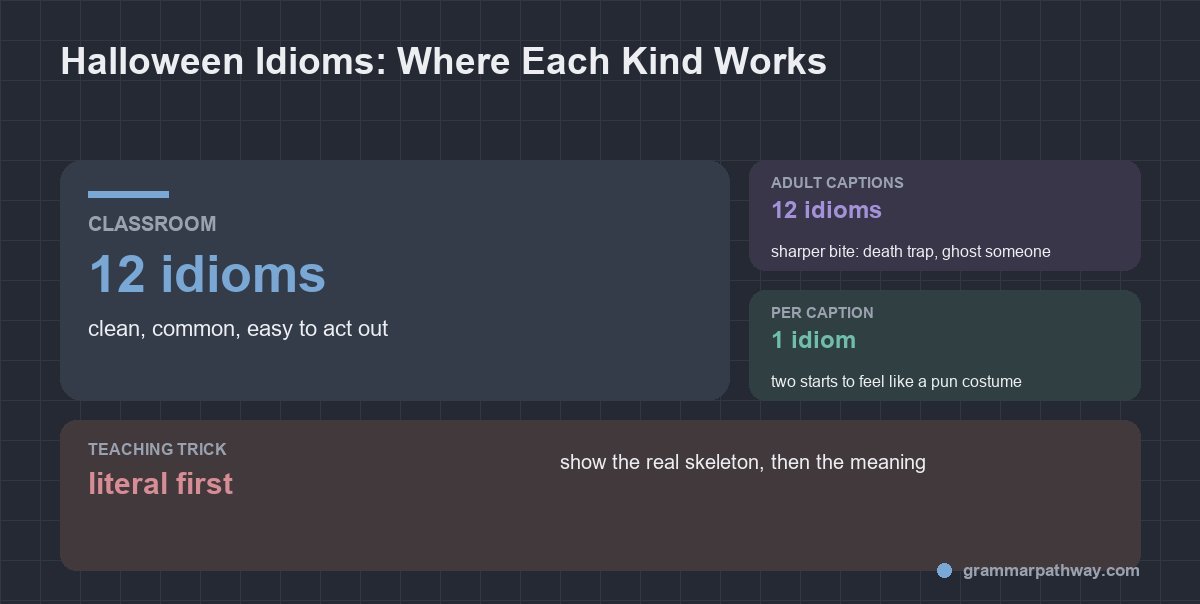
For a caption or invitation, one idiom does the job; two start to feel like a costume made entirely of puns. “Join us at the witching hour” or “come as a dead ringer for your favorite villain” reads clean, while stacking three in a sentence reads like a worksheet. For classrooms, pair each idiom with its literal image (a real skeleton in a real closet) before the figurative meaning; the gap between the two is what kids find funny, and funny is what they remember. Writers wanting the figurative-language cousins, comparisons rather than fixed phrases, can borrow from our roundup of similes for clouds, which follows the same literal-to-figurative logic.
FAQ: Idioms for Halloween
What are some catchy Halloween phrases?
Catchy Halloween phrases lean on the idioms above: “join us at the witching hour,” “no skeletons in our closet, just in the yard,” “scared stiff and loving it,” and “a dead ringer for your favorite villain.” Idiom-based lines outlast pun-only ones because the meaning does work.
What are 10 idiomatic expressions with a spooky twist?
Ten quick ones: scared stiff, ghost town, witching hour, skeleton in the closet, come back to haunt you, dig your own grave, over my dead body, dead ringer, bone to pick, and bat out of hell. Each is ordinary English that happens to sound seasonal.
What are some vintage Halloween sayings?
Older phrasing that still reads Halloween: “the witching hour,” “in the dead of night,” “full of the devil,” and “over my dead body,” all in print for a century or more. Pair one with a vintage-style card and it does the atmosphere for you.
What else can you say instead of “Happy Halloween”?
Try “Have a spooky one,” “See you at the witching hour,” “Stay scared,” or “Wishing you a night full of the devil.” Any idiom from the adult list, dropped into a short greeting, beats the default phrase for a caption or card.
Publishing note for teachers and marketers: these lists are evergreen, but they get searched in September and October, so a worksheet or campaign built now has a full season to circulate.